Multi-Agent Orchestration — Google ADK + Temporal
Last updated Sep 9, 2026
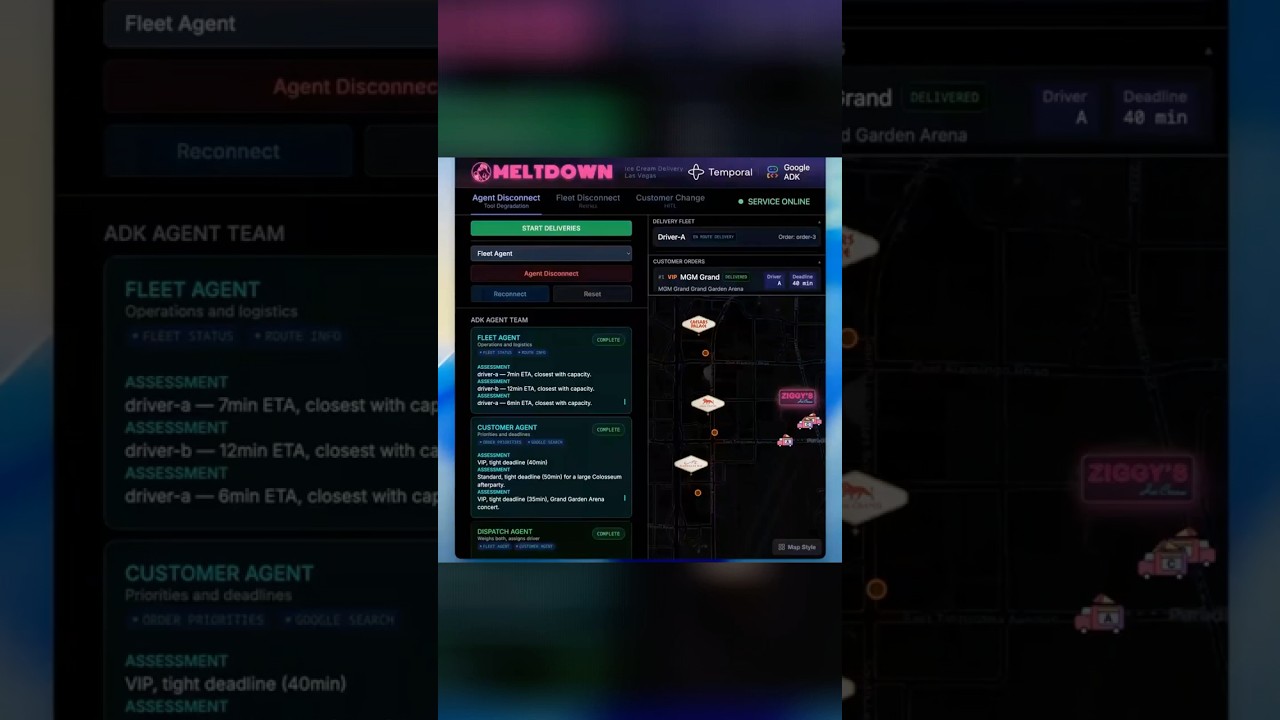
This recipe builds a multi-agent dispatch pipeline using Google ADK and the Google ADK integration for Temporal. Two agents reason in parallel, a third synthesizes their output and submits a structured decision — and every LLM call and every I/O tool call is a durable Temporal Activity. (The final decision write is a plain in-workflow tool — see Structured output via session state.)
ADK ↔ Temporal mapping
| ADK concept | Temporal mapping |
|---|---|
| Orchestrator agent | Pure Python inside the workflow (Runner.run_async) |
LLM call (BaseLlm) | invoke_model activity (via TemporalModel) |
Tool call (@activity) | A named activity (via activity_tool) |
| Session state | Read back from the in-memory SessionService after the run |
| Agent reasoning | Lives in the workflow; durable, replayable |
| Anything that does I/O | Lives in an activity; retried, timed out, observed |
Pipeline
                      ┌──────────────┐
                      │ Order input  │
                      └──────┬───────┘
                             │
            ┌────────────────┴────────────────┐
            │       ParallelAgent             │
            │ ┌─────────────┐ ┌─────────────┐ │
            │ │ Fleet Agent │ │ Customer    │ │
            │ │             │ │ Agent       │ │
            │ └─────────────┘ └─────────────┘ │
            └────────────────┬────────────────┘
                             │
                      ┌──────▼───────┐
                      │ Dispatch     │
                      │ Agent        │
                      └──────┬───────┘
                             │
                  tool_submit_assignment
                             │
                      ┌──────▼───────┐
                      │ Workflow     │
                      │ returns      │
                      │ AssignmentOut│
                      └──────────────┘
- Fleet Agent — checks driver positions, capacity, ETAs.
- Customer Agent — checks order priority, deadline, urgency. (Runs in parallel with Fleet Agent.)
- Dispatch Agent — reads both assessments from session state, picks a
driver, submits the structured decision via
tool_submit_assignment.
This recipe highlights:
- Multi-agent composition with ADK —
ParallelAgent+SequentialAgentdriven by a singleRunnerinvocation. - LLM-as-activity —
TemporalModelroutes every LLM call through aninvoke_modelactivity. Each call appears as a separate event in workflow history with retries, timeouts, and a Temporal-UI summary. - Tool-as-activity —
activity_toolwraps a Temporal Activity so the agent can call it. Each of these tool invocations is its own activity event. (The Dispatch agent's finaltool_submit_assignmentcall is a plain in-workflow tool, not an activity — it only writes to local session state.) - Structured output via session state — the final agent calls a Python
tool that writes to
tool_context.state. The workflow reads that key back after the runner completes. - Sandbox-safe ADK imports — ADK and
google.genaiare imported underworkflow.unsafe.imports_passed_through()so the workflow sandbox does not reject them.
Prerequisites
- Python 3.10 to 3.13
uvfor dependency management- A running Temporal Dev Server (
temporal server start-dev) - A Google API key with access to Gemini (
GOOGLE_API_KEY)
Setup
uv sync
export GOOGLE_API_KEY='your-api-key-here'
Running
In one terminal, start the Temporal Dev Server:
temporal server start-dev
In a second terminal, start the worker:
uv run python worker.py
In a third terminal, kick off an assignment:
uv run python start_workflow.py
You should see a final assignment printed, e.g.:
Assigned driver: driver-a
Reasoning:       Closest available driver with capacity for VIP order
Open the Temporal UI at http://localhost:8233 to see each LLM call and tool call recorded as its own activity in the workflow history.
Architecture
multi_agent_adk_python/
├── activities/
│   └── tools.py             # @activity.defn — fleet status, priorities, route info
├── models/
│   └── models.py            # AssignmentInput / AssignmentOutput (pydantic)
├── workflows/
│   ├── assignment_workflow.py  # agents + workflow inline
│   └── _activity_tool.py       # ADK ↔ Temporal tool adapter
├── worker.py
├── start_workflow.py
└── tests/
    ├── test_activities.py
    └── test_workflow.py        # workflow logic with a mocked invoke_model
Activities as agent tools
Each tool the agents can call is a Temporal Activity:
File: activities/tools.py
async def tool_get_fleet_status() -> str:
    """Return current fleet state: driver positions, capacity, and status."""
    return (
        "Fleet status:\n"
        "- driver-a: pos=(36.1147, -115.1728)  capacity=2/3  status=AVAILABLE\n"
        "- driver-b: pos=(36.1099, -115.1750)  capacity=0/3  status=AVAILABLE\n"
        "- driver-c: pos=(36.1162, -115.1745)  capacity=3/3  status=FULL\n"
        "- driver-d: pos=(36.1213, -115.1700)  capacity=1/3  status=AVAILABLE\n"
        "- driver-e: pos=(36.1080, -115.1760)  capacity=2/3  status=DISCONNECTED"
    )
In a real system the body would query a fleet database or hit an internal service. Here we return canned strings so the recipe runs without any backing infrastructure.
TemporalModel — every LLM call is an activity
TemporalModel (from
temporalio.contrib.google_adk_agents) is an ADK BaseLlm whose
generate_content_async runs through a Temporal Activity. The plugin
registers that activity (invoke_model) on your worker for you.
File: workflows/assignment_workflow.py
def _fleet_agent() -> Agent:
    return Agent(
        name="fleet_agent",
        model=TemporalModel(
            DEFAULT_MODEL,
            activity_config=ActivityConfig(
                task_queue=TASK_QUEUE,
                summary="Fleet Agent — LLM reasoning",
            ),
        ),
        ...
        tools=[_fleet_status_tool, _route_info_tool],
        output_key="fleet_assessment",
    )
activity_tool — every tool call is an activity
activity_tool wraps a @activity.defn so it presents to ADK as a regular
Python tool, but the call body executes via workflow.execute_activity:
File: workflows/assignment_workflow.py
_fleet_status_tool = activity_tool(
    tool_get_fleet_status,
    task_queue=TASK_QUEUE,
    summary="Fleet Agent — get fleet status",
    start_to_close_timeout=timedelta(seconds=10),
    retry_policy=_TOOL_RETRY,
)
The local workflows/_activity_tool.py adds graceful failure on top of the
upstream temporalio.contrib.google_adk_agents.workflow.activity_tool:
when an activity execution fails (retry policy exhausted, non-retryable
application error, timeout), the wrapper catches the ActivityError
and returns it to the LLM as a string so the agent can adapt instead of
crashing the pipeline. (The retry attempts still appear in workflow
history.) Programming bugs — e.g. argument-binding errors — are not
caught and propagate normally. Upstream activity_tool (temporalio>=1.25)
already handles multi-arg activities and local non-workflow ADK runs.
Composing the pipeline
File: workflows/assignment_workflow.py
def build_assignment_pipeline() -> SequentialAgent:
    """Compose the full pipeline: Parallel(Fleet, Customer) → Dispatch."""
    return SequentialAgent(
        name="order_assignment",
        sub_agents=[
            ParallelAgent(
                name="assessment_parallel",
                sub_agents=[_fleet_agent(), _customer_agent()],
            ),
            _dispatch_agent(),
        ],
    )
Fleet and Customer agents run concurrently inside ParallelAgent. When
both finish, the Dispatch agent runs. Each sub-agent's output_key
(fleet_assessment, customer_assessment) writes its final response into
session state — that's how the Dispatch agent gets the upstream context
without passing it explicitly.
Structured output via session state
The final agent calls a plain Python tool (not a Temporal activity) that writes the decision into ADK session state:
File: workflows/assignment_workflow.py
async def tool_submit_assignment(
    tool_context: ToolContext,
    driver_id: str,
    reasoning_summary: str,
) -> str:
    """Submit the final order assignment. You MUST call this tool with your decision.

    Args:
        driver_id: The driver to assign the order to (e.g. "driver-a").
        reasoning_summary: One-sentence explanation of the choice.
    """
    tool_context.state["assignment"] = {
        "driver_id": driver_id,
        "reasoning_summary": reasoning_summary,
    }
    return "Assignment submitted."
The workflow runs the pipeline to exhaustion, then reads that key back:
File: workflows/assignment_workflow.py
async for _ in runner.run_async(
    user_id="workflow",
    session_id=session.id,
    new_message=Content(parts=[Part(text=prompt)]),
):
    pass

updated = await session_service.get_session(
    app_name=APP_NAME,
    user_id="workflow",
    session_id=session.id,
)
state = (updated.state if updated else None) or {}
assignment = state.get("assignment") or {}

return AssignmentOutput(
    driver_id=assignment.get("driver_id", ""),
    reasoning_summary=assignment.get(
        "reasoning_summary", "Dispatch agent did not submit a decision."
    ),
)
This pattern — a tool call that writes structured output into session state — is how you reliably extract a typed decision from a multi-agent pipeline that emits many intermediate events.
Sandbox-safe ADK imports
ADK and google.genai aren't safe under Temporal's workflow sandbox by
default, so they're imported under
workflow.unsafe.imports_passed_through():
File: workflows/assignment_workflow.py
with workflow.unsafe.imports_passed_through():
    from google.adk.agents import Agent, ParallelAgent, SequentialAgent
    from google.adk.runners import Runner
    from google.adk.sessions import InMemorySessionService
    from google.adk.tools import ToolContext
    from google.genai.types import Content, Part
    from temporalio.contrib.google_adk_agents import TemporalModel
The GoogleAdkPlugin registered on the worker handles the rest of the
sandbox passthroughs and deterministic-runtime overrides ADK needs (UUIDs,
clocks).
Worker — one queue, one plugin
File: worker.py
client = await Client.connect(
    "localhost:7233",
    data_converter=pydantic_data_converter,
)

# GoogleAdkPlugin registers the `invoke_model` activity (used by
# TemporalModel for LLM calls) and provides the workflow-sandbox
# passthroughs and deterministic runtime overrides ADK needs.
worker = Worker(
    client,
    task_queue=TASK_QUEUE,
    workflows=[MultiAgentAssignmentWorkflow],
    activities=[
        tool_get_fleet_status,
        tool_get_order_priorities,
        tool_get_route_info,
    ],
    plugins=[GoogleAdkPlugin()],
)

await worker.run()
GoogleAdkPlugin registers the invoke_model activity that
TemporalModel routes LLM calls to — you don't need to register it
yourself.
Extensions
This pipeline is the minimal multi-agent shape. Natural ways to extend it:
- Real backing services — replace the canned tool bodies with real database queries, route APIs, or internal microservices.
- More parallel branches — add agents to the
ParallelAgent(an inventory agent, a credit-check agent, a fraud-screen agent) — each posts its assessment viaoutput_keyfor the synthesizer to read. - Multiple sequential stages — add a validation or post-processing
stage after Dispatch by extending the outer
SequentialAgent. - Human-in-the-loop on the synthesizer — pause before the final
decision via a Temporal Signal. See the
human_in_the_loop_pythonrecipe. - Graceful degradation — fail-fast retry policies on a sub-agent's tools so the synthesizer can decide with partial data when an upstream service is unavailable.